Sunday, May 10, 2015

The Value of What I Learned: Part II

In this post, I would like to talk about the other most important value I gained through this course. I learned that anyone could get a patent. At the start of this course, the idea of filing for a patent was so foreign to me that I was actually intimidated by the thought of it. I took the course in hopes that I would be taught some loopholes on how to be successful in getting a patent, but as it turns out it's a lot easier than expected.

In my mind, I used to save the patent space for the geniuses - for the truly creative and original. From a TED Talk by Kirby Ferguson, everything in life is a remix. Nothing is really original. We build off of other ideas, and this is how we are able to see great technologies evolve into even greater creations. Creativity, in a way, is being able to take something and put your own spin on it - to be able to see how to improve it, even if the improvement is minor. 

My dad has several patents under his name, and before this course I thought that would be impossible for me to achieve. After especially seeing all of those ridiculous patents that were approved, I have more trust and faith in my ability to successfully file for a patent if I wished to do so someday. I like to transfer this confidence to other aspects of my life as well - if I thought this, a not so intimidating process in reality, was scary and unattainable, what else in my life am I overthinking? This course has taught me to reevaluate the confidence I have in my own abilities by equipping me with the necessary knowledge to file for a patent.

Thank you so much for a wonderful semester. I hope to stay in touch with the many of you and with our dearest Professor Tal Lavian.


The Value of What I Learned: Part I

Wow, where to begin on this topic? I learned so much that I will have to choose one topic to discuss. I would have to say that one of the greatest and most valuable lessons I learned was the importance of social media presence.

In class, Dr. Tal Lavian always told us:

"You should be the one in control of what your internet presence looks like, not other people."

Hearing this was like getting a wakeup call. While I tend to be very careful about what goes up on my Facebook because of relatives I am connected with, I had never cared to extend m thoughts to other social media platforms. On one hand, it can be regarded negatively to future employers if you are not searchable. Have you not done anything noteworthy? Are you antisocial? But at the same time, you don't want unprofessional pictures and material to slowly be leaking out either. Employers don't care to hire the antisocial one or the party-goer. 

After initial hestitancy towards my presence on Twitter, I learned to grow an appreciation for it. It helped me stay up to date with current events, and I will definitely be keeping my account to help improve my internet presence. I think it's important for future employers to know that there is more depth to you beyond your 2-dimensional application. At a time of graduation and entering the professional world, these become important considerations. 


Saturday, May 9, 2015

Collaborative Learning through Social Media: Part II

Collaborative Learning = an educational approach to teaching and learning that involves groups of students working together to solve a problem, complete a task, or create a product

In 1994, Gerlach stated "collaborative learning is based on the idea that learning is a naturally social act in which the participants talk among themselves. It is through the talk that learning occurs."

And it is actually very interesting to think about - how do we study for exams? Do you use study groups? I personally learn the most when I study with others for an exam. It is the process of writing, listening, and verbalizing your thoughts which leads to actually learning. Studies have shown that we learn material more effectively when we are actively engaged and conversing with peers. The exchange provides multiple viewpoints and requires the articulation and defense of ideas.


Twitter

Let's consider Twitter, for example - a micro-blogging platform that is used for:

  1. Keeping in touch
  2. Online research
  3. Live tweeting
This is a good representation of collaborative learning through social media because we used it in class. During a couple of lectures, we used Twitter as a space to talk and enhance classroom discussion by tweeting and retweeting each others' posts regarding the in-class lecture topic. 
Furthermore (and most importantly), a space like Twitter allows for professional networking with industry leaders, social leaders, prospective employers, and alumni. Live tweeting and retweeting allows you to become a leader yourself in your field. And lastly, the hashtag search system allows for efficient online research through an interactive window.

And other universities are trying this out, too! Georgia Southern University and UT Dallas have engaged in similar class activities with Twitter as a study on collaborative learning through social media:
https://makingconnectionsfye1220.wordpress.com/2008/09/09/assignment-48-hours-of-twitter/
http://www.utdallas.edu/~mrankin/usweb/twitterconclusions.htm

The results from UT's experiment were telling. The twitter experiment required students who normally would not participate to engage in dialogue. 

I think it is important as an educator to actively think and rethink of new teaching techniques, and Dr. Lavian truly embraces that in this course.


Collaborative Learning through Social Media: Part I

The semester is coming to an end, and I would like to reflect on the unique learning style Dr. Tal Lavian took in teaching this course a UC Berkeley.


The majority of the universities heavily follow the 'tutor contact' and 'independent study' teaching methods that can be seen in the venn diagram above. More universities and colleges are starting to take on the 'practical' learning application as well, although only a select few of my classes here at Berkeley have fallen under that category. Out of those select few, they have actually been some of my favorite courses. However, IEOR 190G has been the only course to follow the 'social networking' category.

If we observe the diagram above carefully, you can see that Social Networking falls under all 3 core teaching methods: tutor contact, independent study, and practical. What's so great about the Social Networking platform to learning is that it creates a space for the students to collaborate, learn from each other, and offer support to one another. In addition to learning we are able to create a closer community and make friends. Unfortunately, when courses lack collaboration, relationship-building is consequently not encouraged and students will take away much less at the end of the term.

The other great thing that the Social Networking approach to learning offers to students is creativity. We have TIME to think and compose our thoughts and then further develop them. Due to social media's relative informal context, we can express ourselves and our thoughts in our own unique, individual ways.

I enjoyed the social media aspect of this course because it felt far more hands-on than any course I have taken. Assignments involved researching current events in the patent world: I was able to become aware of tech news that I never would have thought of keeping up-to-date with. Because of this class, I realized how easy it is to look up patent-related news! Google has a page under their 'News' section. I've become interested in keeping up with the Economist to stay ahead of market news and changes. Lastly, I have come out of this course with friends and that has been wonderful!


Friday, May 8, 2015

Efrat Kasznik (Extension): IP in Software


I talked a little bit about the graph above in my previous post in regards to the importance of patents in biotech and medical device industries. But why are patents significantly less important in the field of software?

Time. Within the software industry, technology is rapidly changing. This means that software patents hardly live to use the full extent of their life. It may simply not be work paying for a patent when drastic changes are often being made in the industry. In fact, most software VCs see little benefit in filing for a patent.

Copyright. Copyright protection, as you can see in the chart above, is the most common form of protection used within the software industry. Copyright can be a better choice because there is a difference between executable and editable code. Furthermore, copyright protection is more cost effective and takes into effect immediately!


Efrat Kasznik: Why Startups Don't File for Patents

The Berkeley Patent Survey (2010):
"For your last innovation you did not patent, which if any of the following influenced
your company's decision?"

These were the top reasons reported by startups for not filing patents. The two most popular responses were related to the cost of patents.

Although Obama's America Invents Act (AIA) as aimed to help small businesses in the realm of IP, it has actually made it rather difficult for them to file for patents.

  • First to File
    • Before 2013, patents were granted to the first inventor; however, now the patents are granted to whoever is able to get the patent application to the patent office first. What does this mean for startups? They need to shell out all the cash for patent filing well before they know whether or not the patent idea has a chance of working.
  • Patentability of Trade Secrets
    • Previously, patents and trade secrets were mutually exclusive. If a company kept a trade secret undisclosed for more than a year, it couldn't be patented. However, under the AIA companies could treat an invention as a tradesecret for years and then patent it later. This is good for big companies, but small companies usually do not have tradesecrets.
  • Post-Grant Opposition
    • The AIA allows a third party to challenge the validity of a patent within its first 9 months of issue. Small companies, who may be unsure of the validity of their patent early on, will be unable to file broad patents. The elimination of broad patents is good overall, but it makes it very difficult in the patent field for startups.
  • Fast Tracking
    • Companies can now "fast track" a patent application for a fee to get it processed quicker. The USPTO charges an extra fee of $4,800 or $2,400 for businesses with less than 500 employees for this fast track process. Small startups are unlikely to take part in the fast tracking of patents due to the higher fees, making this an additional benefit to large companies through the AIA.


Efrat Kasznik (Extension): Patent Trends in Startups

The Berkeley Patent Survey (2010):
"For your last innovation you did not patent, which if any of the following influenced
your company's decision?"

These were the top reasons reported by startups for not filing patents. The two most popular responses were related to the cost of patents. In fact, other studies show that startups are becoming increasingly unlikely to file for patents with time. This trend is true for companies who never apply/applied for patents, but it's the exact opposite from companies who have applied for at least one patent. Companies who file for at least one patent are actually more likely to apply for more patents. In fact, they are applying for a greater number and at a fast pace.

The deciding factor for startups in patent application is highly dependent on influence from VC investors. A case of at least 80% of companies backed by large companies such as Samsung Ventures, Johnson & Johnson Development Corp., and Motorola Ventures have filed at least one patent. Healthcare investors, such as De Novo Ventures and Delphi Ventures, are among the highest in patent emphasis with a minimum of 90% of their funded companies having filed at least one patent. However, seed-stage, or "angel", investors round out at the bottom: only about 13% of companies funded by VCs such as 500 Startups, SV Angel, and High-Tech Gruenderfonds have filed patents.


Tuesday, May 5, 2015

Efrat Kasznik: Competitive Advantage of IP

On April 20th, Efrat Kasznik, Founder & President of Foresight Valuation Group, LLC, was our guest speaker in class. Her presentation was on the role of intellectual property in the scope of strategic business assets. In this blog, I will be discussing the importance of intellectual property by industry, as discussed in her presentation.


The chart above shows the relative importance of having IP according to a Berkeley patent study done in 2010 on the following industries: biotechnology, medical devices, and software. I was particularly interested in looking deeper at these statistics because as a Bioengineer, I am right at the center of these three industries. I have experience in medical devices and will be working post-graduation at a biotech company. 

Overall the chart shows that having a patent is least important in providing a competitive advantage to the software industry. This falls inline with the research that we've done all semester long in understanding how vague and problematic software patents are. According to the OECD, number of patents that were granted in biotech increase 15% between 1990 and 2000 in the USPTO.

One of the reasons why patents are so important in the field of biotech and medical devices is that R&D is a huge part of the business model in these industries. Therefore, the protection of research outcomes becomes a huge concern. Another key factor in patent importance in these fields is the large costs associated with the development of their industry products. Venture capitalists consider the cost of research alone in these industries to be considered a high risk cost. Additionally, I think a driving point is that for some companies within biotech/medical devices, a patent is the final product.


Monday, May 4, 2015

TED Talk: Ellen 'Thoen, Pool Medical Patents Save Lives

In Ellen 'Thoen's TED Talk, she begins by speaking about the Wright brothers' patent myth. The myth states essentially alludes the Wright brothers to be patent trolls.

In the early 1900s, the Wright brothers were patenting various aspects in the early innovation of the airplane. Reportedly, the Wright brothers were not actually using these patents and instead were aggressively sending licensing demand letters to "infringers". The US government claimed that the Wright airplane patent was "injurious to the development of aircraft...in the United States" and eventually put a stop to their allegations. The US forced the Wright brothers to make their patent available to others so not to hinder the advancement of the aircraft industry for US military purposes.

'Thoen sees a connection with this and pharmaceutical patents. In 2010, the United Nations established the Medicine Patent Pool (MPP) which serves similarly to the aircraft patent pool in the US a century ago. MPP provides affordable access to HIV medication to people living with HIV in developing countries. This was established as a result of when the World Trade Organization initiated new rules in 1995 which called for all countries to ensure 20-year patents for new medications. This has dramatically increased the number of patents in the area of antiretroviral drugs and medications in general.

I agree with 'Thoen in that we must "move from conflict to collaboration". This move towards alliance between pharmaceutical companies and nations will help us strengthen one another and reach a cure for epidemics such as HIV/AIDS.


Sunday, April 26, 2015

TED Talk: Johanna Blakley, Lessons from Fashion's Free Culture

Johanna Blakley shed some light on the realm of intellectual property rights in the fashion industry...or lackthereof. The fashion industry only has trademark protection, but no copyright protection - no patent protection. Because of this, often times designers plaster their logo all over their designs.

The reason that the fashion industry has so little IP protection is because the courts decided long ago that "apparel is too utilitarian to qualify for copyright protection".

"Without ownership, there is no incentive to innovate."
Blakley argues against this quote and believes that this lack of copyright protection is the reason for the consistent burgeoning of creativity in the fashion industry. She states that "there is a very open and creative ecology of creativity" in this industry. This is because fashion designed can sample elements from other garments, from any point in history, and create new art. This is directly in line with the idea of remixing that was discussed in my previous post (Krisby Ferguson's TED talk). And this remixing doesn't only happen at the highend - regular individuals out in the streets are always mixing and matching different garments, creating new looks. This "copy" culture has created a both top down and bottom up approach to creativity.

Blakley discusses why copying hasn't destroyed the industry. The bottom line is that knock-offs are never the same as the original: the customers between the knock-off and high end trails are different.


TED Talk: Kirby Ferguson, Embrace the Remix

Remix = copy + transform + combine

Kirby Ferguson believes everything in life is a remix - all the new technology, new ideas, new arts. They are all derivative, and I agree with this to some extent. While I agree that perhaps 99% of the time new inventions are simply reinventions of other ideas, I believe that there is (and we need) about 1% of those inventions to be truly new and transformative. Ferguson states that "our creativity is from without, not from within", but I truly believe it is a combination of external factors and your own born ability to innovate. If creativity was truly from without, then we would see more individuals with the ability to create new ideas - but we don't. There is a difference between modification and invention. The creativity to modify can be learnt but now to invent.

Ferguson spends a lot of time talking about how 2/3 of Bob Dylan's music is a copy of other people's songs and then jumps into talking about "Apple's" multitouch technology. I see the connection Ferguson tried to make between tech and arts, but I thought the transition was a bit mismanaged. Starting with the Bob Dylan example, I personally did not hear or notice much similarity between the melodies of Jean Richie's Nottamun Town and Bob Dylan's Masters of War; melodies of Dominic Behan's The Patriot Game and Bob Dylan's With God on Our Side; the lyrics of Paul Clayton's Who's Gonna Buy You Ribbons and Bob Dylan's Don't Think Twice, It's Alright. If we were to take all of the century's songs and compare tunes, melodies, lyrics, meanings, what have you, we will certainly find similarities. It's just bound to happen. Not one idea is wholely unique, and this is not necessarily as a result of exposure to existing ideas. I do agree with Ferguson, though, that this concept of remixing ideas is essential to improvement in everyday life.


"The words are the important thing. Don't worry about tunes. Take a tune, sing high when they sing low, sing fast when they sing slow, and you've got a new tune." - Woodie Guthrie


Saturday, April 25, 2015

TED Talk: Drew Curtis, How I Beat a Patent Troll

At the beginning of 2011, Drew Curtis, founder of Fark.com, was sued for patent infringement by a Gooseberry Natural Resources, LLC. Gooseberry also sued Yahoo, MSN, , Reddit, AOL, and others for the same thing. What have all of these companies been infringing on? Apparently Gooseberry claimed rights to the creation and distribution of news releases via email...

The problem is that patents are always being granted for ideas/processes that are already being done. Adding to this problem, the patents are worded obscurely. As a result of this dysfunctional patent system, most of these troll lawsuits end in settlements under non-disclosure agreements. Unfortunately, this means we never find out what the terms of the litigation were. Patents trolls use this to their benefit since they can go on and tell others that they won.

Drew Curtis tells us that the average patent troll defense costs roughly $2 million and over 18 months if you WIN.

Curtis actually realized that Fark.com was NOT in violation of this patent and intended to go on and help the other companies Gooseberry was attacking, but they were all settling!

Curtis' advice on fighting a patent litigation is:
- Don't fight the patent, fight the infringement
- Make it clear from the beginning that either you have no money or that you would rather spend your money fighting the troll
- Reinforce that you will make the process as annoying as possible


Friday, April 24, 2015

Frameless glasses attaching to body piercing studs


US 6557994 B1

This is by far the most useful invention of the four I've mentioned here. John Rose really looked into the heart of the problem with wearing glasses....

In all honesty, eye glass wearers always trouble with keeping their glasses sitting upright on the bridge of their nose. This patent is non-obvious, novel, and certainly useful (to those willing to get all the piercings to make this happen). 

In actual practice, you need to pierce an internally threaded barbell that would be inserted through the skin above the bridge of your nose. Then you would need to screw on L-shaped magnetic metal pieces that would secure the bifocals on your face. The glasses are reinforced with nose pads. The downside is that you need to screw in the L-shaped pieces on everytime you want to put on the glasses - not to mention that you would be in some serious trouble if someone hit your face.... On the upside, this invention might have some potential use given that the younger generations find excessive body piercings to be fashion forward.


Thursday, April 23, 2015

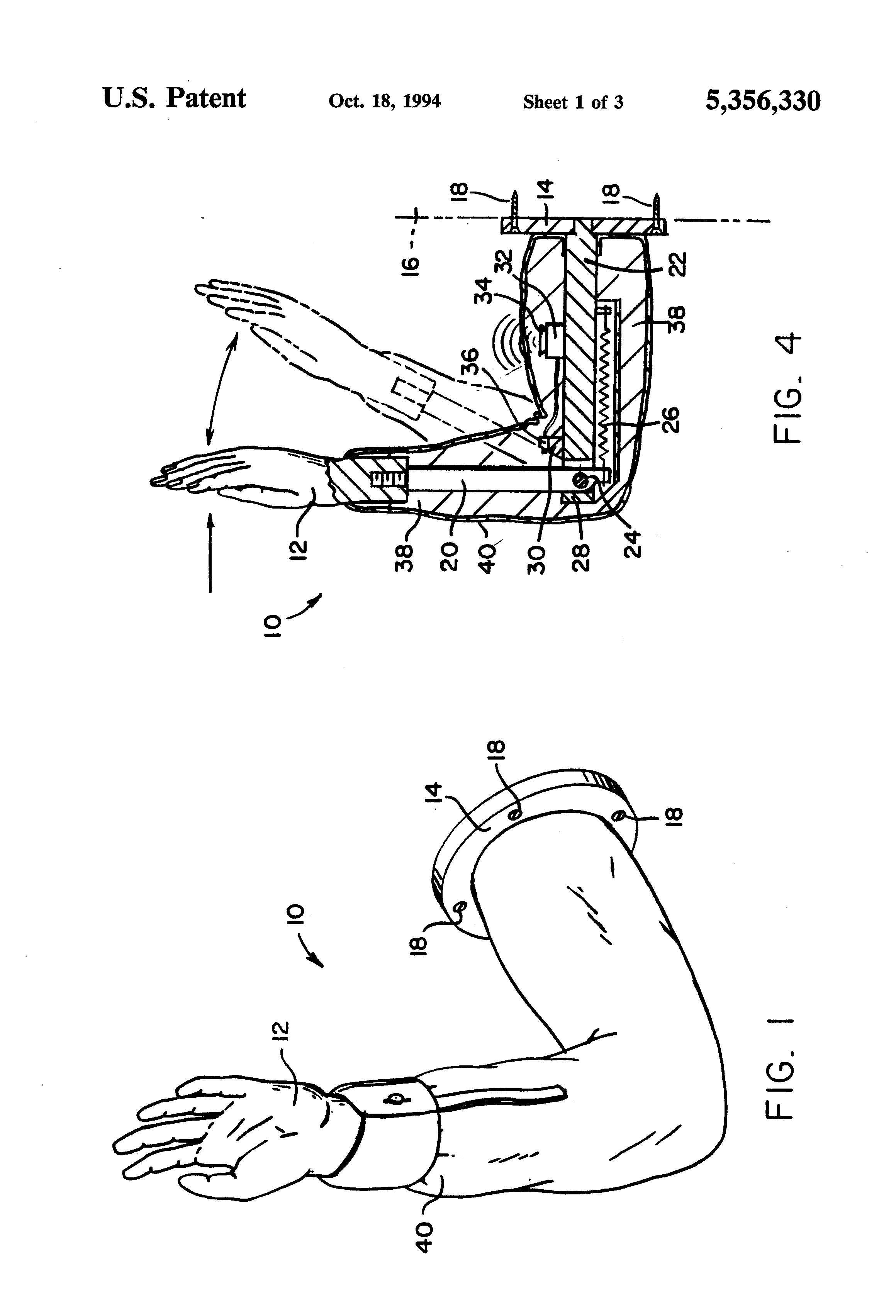
Apparatus For Simulating a "High Five"

US 5356330 A

Albert Cohen was concerned with the disadvantages of watching sports games alone and therefore developed an apparatus which would allow lonely sports fans to share the excitement of a 'high-five' with this device. In fact, in the patent he explains, "During a televised sporting event, a "high-five" is commonly shared between fans to express the joy...of a touchdown, home run,...[etc]. Unfortunately, as known in the art, a "high-five" requires the mutual hand slapping of two participants... As such, a solitary fan is unable to perform a "high five" to express excitement during a televised sporting event."

This simulated hand device can be mounted against a "table, wall, floor, or the like", the patent states.

As if the aforementioned purpose of this invention wasn't enough, Cohen further explains, "...the hand-arm configuration synergistically improves the hand-eye coordination of a user..., provides an exercise device for enhancing the jumping skils of a user. More specifically, when the hand-arm configuration is mounted ata suficient height above the normal reach of a user, th user must jump upwards to strike the simulated hand, thereby simulating many of the jumping drills commonly practiced by basketball players. As such, the leg strength and coordination of a user may be improved through the practice of the present invention."

I don't know about you, but he really sold it to me.


Garment having a buttocks cleavage revealing feature

US 6473908 B1

Thomas Bontems really outdid himself with this invention. Even though the buttocks crack doesn't have a generally positive connotation, it seems as though some individuals may want to expose that part of their body! 

This invention allows you to wear pants with a stylish cutout with sheer material, subtly exposing that precious part of your body. Bontems even has a Chevorlet logo cutout example in his images to show the possibility for corporate advertising!

According to Bontems, people actually do like to expose parts of their anatomy - the problem is that they aren't comfortable wearing tight fitting or low cut jeans. His invention "incorporates a revealing feature that does not detract from or govern the overall structure of the garment."

Too bad the patent expired just 5 years after he filed due to failure of paying the maintanence fee. 


User-Operated Amusement Apparatus For Kicking the User's Buttocks


US 6293874 B1

Joe Armstrong applied for this Buttocks Kicker patent back in 2000 - surprisingly enough, the USPTO granted Armstrong the patent. 

What's its use? Well, the patent states it is an amusement apparatus for "entertainment and comic relief whereby the plurality of rotating arms rotate when the user rotates the hand crank." 


I guess the inventors thought this had a great potential application for punishing your children or gaining some pleasure for new S&M techniques.... 

There have been other self-spanking patent inventions, but others required the resetting of the paddles after each blow to the behind. Thankfully, Joe Armstrong created a smooth and continuous self-spanking apparatus. 


Not only was this cranking technique application unanticipated, the prior art supports the novelty claim. Not only were existing self-spanking devices poorly operating, they were also operating via a means of pivot-trigger-reloading. 


Wednesday, April 22, 2015

Ford and the Patent Trolls

Back in 2014, Ford Motor Co. in San Francisco was sued 107 times for patent infringement by patent trolls. In fact, the numbers have been rolling up in the last 5 years - there were only 17 patent infringement lawsuits from trolls agains Ford back in 2009.

As a means to solve this rising problem, Ford recently signed a contract with RPX Corp., a type of open-source company. RPX claims to have over 200 companies signed and helps protect those companies from NPE litigation. Interestingly enough, RPX functions similarly to patent trolls in that they buy patents from the open market, but they claim to put their patents to good use. RPX removes "patents from circulation before they can become costly problem for [their] clients."

Other companies within RPX's member portfolio include Samsung, Intel, and Microsoft.


At the moment, RPX's patent portfolio predominantly includes information technology, but this may prove increasingly useful to Ford and other automotive companies in the next few years as cars are beginning to rely more heavily on software.


This won't be the first time in history that Ford has stood up to patent trolls. George Selden, a patent troll, began filing lawsuits against patent infringement around 1900 against companies like Cadillac, Packard, and Ford. All of the companies settled out of court with the exception of Ford. Henry Ford fought the lawsuit and won.


Sunday, April 12, 2015

Life360 v AGIS

Life360 is a family networking mobile app that allows family members to communication with and track down other family members' GPS locations, among other features.


Advanced Ground Information Systems (AGIS), on the other hand, has a funny looking website and claims to offer exchange of data, voice, and video for military tactical operations. Check out the front page of their website:


The funny bit was that AGIS sued Life360 the same week in which the latter had $50 million in financing, and when Life360 researched AGIS their LinkedIn showed no employees and their corporate headquarters was stationed at a waterfront mansion.

AGIS claimed that any company showing a location marker on a map or connects a group of individuals using a location-sharing service is infringing. The matter took to the federal court, and Life360 stated that AGIS would need to license their entire patent portfolio to all other startups, otherwise they will attempt to invalidate their entire IP portfolio. Luckily for Life360, their strong defense won them a verdict of non-infringement.

Life360 offers the following advice to others who are experience bullying from patent trolls:
- Go nuclear: publicly call them out for what they are
- Share information and resources: open-source all prior art collected, draw attention to your case by offering free legal advice to others in the field
- Go with your gut and commit to it: you're less likely to be approached with trolling lawsuits if you have a history of making the legal process difficult


Patent Troll: Personal Audio on Podcasting

Personal Audio, LLC is a company that was started in 1996 for the sole purpose of enforcing two podcasting patents. The company also earns licensing revenue from five other patents.

One of the claims filed in Personal Audio's patent includes:
(1) "An audio program and message distribution system in which a host system organized and transmits program segments to client subscriber locations."

These patent trolls have been suing companies like Apple, Samsung, Sandisk, and more for the last decade for infringing on their "podcasting" patent. The issue really hit media in 2013 when Personal Audio started demanding licensing fees from podcasters, including the comedian Adam Carolla and two television networks.

The big problem with Personal Audio is that they don't actually do podcasting - instead, they use their patent to claim infringement and collect payouts!

Finally on April 10, 2015 the USPTO invalidated Personal Audio's claims used to threaten podcasters in a petition for review from the Electronic Frontier Foundation (EFF). EFF was able to show that Personal Audio did not invent anything new before it filed its patent proved the prior art in which people have been podcasting for years previously.

Yay for crushing the patent trolls!


Innovation Act and Universities

There has been a lot of criticism towards the Innovation Act set forth by House back in February 2015. The Innovation Act is intended to eliminate patent trolling, but it may negatively impact universities who are joinders of patents through their alumni.

Some supporters of the bill state that it will protect small- and medium-sized business owners who typically settle when they can't fight the patent infringement costs in court; however, it may prove difficult for universities to enforce their own patent rights.

The two points in debate include:
(1) The losing party in the patent infringement is held liable for the winning party's legal fees.
(2) If the losing party cannot pay those fees, co-owners of a patent are required to cover the legal fees.

Point 1 is bad news to startup companies who have limited funds to pursue complicated litigation, while point 2 will involuntarily adjoin the university in select patent lawsuits. Although some argue that the universities likely will not be affected by these provisions due to the wording of the bill, others argue that the bill is too ambiguous about when fee shifting and joinder would apply.

As of now, more than 120 universities oppose this bill.


Monday, April 6, 2015

NPE (Part II)

Are NPE's actually the biggest contributors of patent litigation?

Just as Congress was preparing for the reform on patent policies, the US General Accountability Office (GAO) conducted a study on NPE's and patent litigation as a part of the historic America Invents Act (AIA). The findings actually showed that it is operating companies and not NPE's that drive most patent litigation.

Some interesting details from the GAO Study:

  • Only 1/5 of lawsuits are by NPE's while the rest of the majority is caused by companies which make products.
  • Increase in patent litigation between 2010 and 2011 is likely explained by the anticipation of change to the US patent system.
  • Patent trolls live to SUE

So if NPE's aren't the problem, what is wrong with the patent system?

The problem seems to reside within Patent Monetizing Entities, specifically software-related patents, and the fact that the PTO has not been doing enough to ensure a better quality of patents are being ensued. 


Bottom line is that the GAO report finds there is no patent crisis by identity of the patent owner and rather, the crisis lies within the quality of patents.


NPE (Part I)

Non-Practicing Entities (NPE's)

Also known as "patent trolls". According to PatentFreedom, NPE's are "any entity that earns or plans to earn the majority of its revenue from the licensing or enforcement of its patents." By this particular definition, NPE's do not sell products or services. Furthermore, what makes these patent trolls interesting is that they typically do not infringe on existing patents.

Many individuals end up lacking the time, man-power, and funds to undergo the necessary research and development for establishing a product from a patent. This leads to the licensing and outsourcing of patents which unfortunately usually leads to being swept up by these patent trolls.

For example, 25% of NPE's only enforce patents that they acquired through others.


The following is a charge of patent lawsuits that involve NPEs over time:
Patent Lawsuits Involving NPEs Over Time

This growth is observed due to:
  1. Growth in the market for patents
  2. Operating companies that are seeking to build a patent portfolio


Thursday, March 26, 2015

How to do a Patent Search to Avoid Obviousness

Inventor's Learning Center has a great tutorial for conducting a prior art search. It's critical to perform a thorough search before submitting your patent (or even before working on it) so to avoid infringing on another patent or running the risk of submitting an "obvious" invention. 

Start by compiling a list of features and functions. Afterwards, create a list of synonyms that describe each of your invention's features. These words should go into your keyword searches.

Make a note of any inventions that look similar while paying attention to their classification. Repeat your keyword search within each referenced classification for a more refined search.

This is a good starting point for performing your prior art search. 


Wednesday, March 25, 2015

Sterne's "Obviousness is King"

Rob Sterne is the editor-in-chief of the Patent Office Litigation, and in this video he explains the concept of obviousness in patents and how it has transformed since the contested proceedings on September 16, 2012.  

Sterne's predictions that the new proceedings will focus more so on seconding guessing the original patent examiner instead of questioning the actual obviousness of the patented invention. He believes that the process of defending the patent-ability of ones invention will become increasingly difficult for the inventor due to the very short time period the proceedings will now take.

Proceedings must be completed within 12 months!

Agreeably, the process for defending the non-obviousness of ones patent should be limited to a time frame; however, this can be very difficult to handle due to the often exacerbated timelines given via the court and attorneys. 


Obviousness (Part II)

How can we argue for the obviousness of a patent?

We must argue that there is "no teaching, suggestions, or motivation to combine the [prior art] references and that the resulting combination of elements would not have been understood to produce predictable results by someone skilled in the art." (Gene Quinn)


Furthermore, it is imperative to show that the prior art references are from different fields in order to strengthen the argument for non-obviousness.


Obviousness used to be tested using the TSM Test:
Testing
Suggestion
Motivation

The test requires the examiner to prove that some suggestion/motivation exists to combine the referenced elements. Now the Graham Analysis is used as the standard in arguing for obviousness in order to maintain a broader, more holistic evaluation of the patent.

Graham factors include:

  1. scope and content of prior art
  2. level of ordinary skill in the art
  3. differences between claimed invention and prior art
  4. objective evidence of non-obviousness
    • commercial success
    • long-felt, unsolved needs
    • failure of others

Obviousness (Part I)

obvious
[ob-vee-uh s]

adjective (Dictionary.com)

  1. easily seen, recognized, or understood; open to view or knowledge; evident
  2. lacking in subtlety


To reiterate from the last weeks, patents according to law must be "non-obvious". This is further elaborated by defining that "a person having ordinary skill in the art would not know how to solve the problem at which the invention is directed by using exactly the same mechanism". (Farflex Dictionary)

The concept of obviousness also takes into account the number of cites required in order to justify the patent. AKA the more prior art references, the more non-obvious the patent is likely to be.


Monday, March 16, 2015

Elaboration on Anticipation and Obviousness

US 2661889 A
Patent Title: Thermal Coffee Cup
Being that this patent was filed in 1948, I believe it was a novel technology and therefore not anticipated. I make this statement because the prior art does not exist in a means that would jeopardize the novelty of this idea. 

The patent has one single claim. Interestingly enough, this gives us some insight on how different the patent regulations were 65 years ago. It claims:
In an insulated container jacket, 
the combination which comprises an outer frusto conicalshaped sleeve 
and an inner corrugated lining
having a plurality of open vertically disposed separated channels 
therein with both the upper and lower ends of said channels open
and with the inner surface of the lining also frusto conicalshaped
and a cup-like frusto conical-shaped container 
the upper and lower ends of which are rolled inwardly 
with a closure permanently secured in the lower end
an outer ring having a bead 
with a groove in the inner surface around the upper end of the container 
and a cap secured in the groove of said ring.

The way the patent is claimed leaves great room for patent improvements, which can be observed in the number of patents on thermal sleeves that were filed in the number of decades after.


US 7922031 B1

Patent Title: Insulator sleeve for a beverage container
I believe this patent was non-obvious in many ways: as one who regularly uses thermal sleeves, I had never considered a reusable thermal sleeve. The novelty is further highlighted in making the sleeve clear for convenient use when ordering at coffee shops. This was the first mention of an eco-friendly, smart thermal sleeve.

The first claim states:
An insulating sleeve combination for a frusto-conical beverage cup,
 the cup including an outer peripheral surface, the combination comprising:
an opaque frusto-conical inner sleeve, 
the inner sleeve including an inner surface for engagement with the outer peripheral surface of the cup, 
an outer surface adapted for accepting printed indicia
a top edge and a bottom edge, 
wherein the inner sleeve comprises an arcuate section of a paper-based material having a top edge, 
a bottom edge, 
and two side edges, 
the two side edges being fixed to one another and the arcuate section folded to form the frusto-conical inner sleeve;

a frusto-conical outer sleeve, 
the outer sleeve including an inner surface for engagement with at least a portion of the outer surface of the inner sleeve, an outer surface, a top edge, and a bottom edge; 
the outer sleeve having an inside diameter sufficient to allow at least partial insertion of the inner sleeve within the outer sleeve 
such that the inner and outer sleeve are coaxially aligned.
This patent, as opposed to the prior above, is far more detailed. This is precisely why it makes it increasingly difficult to build off of such a patent.


Monday, March 2, 2015

Was it Obvious? Was it Anticipated?

I'd like to address the obviousness and anticipation of the patents mentioned in my previous post:
  1. Insulating Sleeve
  2. Thermal Coffee Cup
  3. Thermal sleeve, method for manufacturing a thermal sleeve, and combination cup and thermal sleeve
  4. Insulator Sleeve for a Beverage Container
  5. Temperature-Indicating Sleeve and Related Container
  6. Sleeve Construction for Improved Paperboard Cup Insulation
  7. Beverage Cup Sleeving System and Method
  8. Protective Sleeve
  9. Hot and Cold Cup Sleeve 
First we should define the terms (as defined by Wex Legal Dictionary):
Obviousness = ""A person having ordinary skill in the art" would not know how to solve the problem at which the invention is directed by using exactly the same mechanism."

Anticipation = "A grounds for invalidating or rejecting a patent because it means that the claimed invention lacks novelty. Patent invalidity based on lack of novelty, or anticipation, requires that the invention was known or used by others before it was invented by the patentee."

Insulating Sleeve
This patent personally seems obvious. The concept of insulating sleeves was well in existence by the year 2000, and simply adding air gaps to improve insulation from the user does not seem novel enough for a patent.

Thermal Coffee Cup
Given the priority date of 1948 and a lack of prior art, I believe this concept was both non-obvious and unanticipated. 

Thermal sleeve, method for manufacturing a thermal sleeve, and combination cup and thermal sleeve
The patent at hand appears obvious to me but still novel in application. Other patents discussed have been demonstrated as providing insulation from the user's hand rather than providing thermal insulation in order to maintain content temperatures. Additionally, I believe the manufacturing process is novel to patent.

Insulator Sleeve for a Beverage Container
Without a doubt, I believe this is strongly unanticipated and non-obvious. This invention in particular has large potential to revolutionize the market and move toward a "green" solution. There already exist a slew of non-disposable cups, and it follows the societal trend to create a non-disposable sleeve.

Temperature-Indicating Sleeve and Related Container
I believe that this patent is obvious but unanticipated. In my opinion, adding a temperature indicator is a rather obvious solution for determining whether a beverage is at an optimal temperature for consuming; however, I question the practicality of the invention. 

Sleeve Construction for Improved Paperboard Cup Insulation
I do not believe this patent to be truly novel and useful in its entirety. Adding multiple air gaps is an obvious but inefficient concept for insulation.

Beverage Cup Sleeving System and Method
Given that this patent's priority date is after that of the Insulator Sleeve for a Beverage Container, I believe that this technology is highly obvious and anticipated. It is essentially the same as the said patent, however, without the translucent quality. 

Protective Sleeve
I do believe that the manufacturing is non-obvious and unanticipated. This patent specifically addresses improving the economic and environmental impacts through enhancing the manufacturability of the product.

Hot and Cold Cup Sleeve 
I believe this patent is non-obvious in the sense that not all persons skilled in this art know how to solve the issue of condensation ruining existing sleeves. Furthermore, I believe the patent was not anticipated.


Sunday, March 1, 2015

Insulation Patents Summaries

In this blog, I'd like to give a brief summary of a list of patents and patent applications related to various container insulation technologies.

US 6343735 B1
Patent Title: Insulating Sleeve
Priority Date: May 4, 2000
Problem(s) Stated: Disposable foamed plastic cups do not insulate a user's hand from the temperature of the liquid inside the container.
Invented Solution: A sleeve made from flexible material will be used in conjunction with a container to insulate a person's hand from the temperature of the contents inside the container through the implementation of a spaced apart portion between the sleeve's side wall and the container's edge.
Claims: (1) The insulating sleeve will conform to the sidewalls of the container, while portions of the sleeve will be positioned angled away from the sidewall and separated in order to create a gap. (4) The sleeve has a structurally weakened area near the said spacer which tears when the container is inserted into the sleeve. (5) The sleeve is shiftable between a flat storage configurations and an open use position. (8) The insulating sleeve has a top and bottom tubular opening for receiving the container.
Representative Diagrams:

US 2661889 A
Patent Title: Thermal Coffee Cup
Priority Date: July 20, 1948
Problem(s) Stated: Not stated.
Invented Solution: To provided a combined holder and coffee cup that's simple, cheap to manufacture, and provides convenient use to the user in which a portion of the cap can be torn away to permit drinking while keeping the contents heated.
Claims: An insulated container jacket combines a conical-shaped sleeve with an inner corrugated lining with both upper and lower ends open. The upper and lower ends are rolled inwardly and permanently secured.
Representative Diagrams:

US 8251277 B2
Patent Title: Thermal sleeve, method for manufacturing a thermal sleeve, and combination cup and thermal sleeve
Priority Date: April 15, 2005
Problem(s) Stated: Not stated.
Invented Solution: A laminate cup sleeve made of creped paper, adhesive, and a paper substrate will enhance the ease of holding onto the cup sleeve. A method for manufacturing the cup sleeve is provided.
Claims: (1) The cup sleeve comprises of a creped paper product which has a first end, second end, first cup opening, and second cup opening and an adhesive that holds the first and second end together to enclose a cup. Further dimensions are provided. (10) A combination of the cup and cup sleeve comprises of the cup and the cup sleeve.
Representative Diagrams:

US 7922031 B1
Patent Title: Insulator sleeve for a beverage container
Priority Date: March 1, 2006
Problem(s) Stated: The use of insulator sleeves instead of double-cupping in order to insulate temperatures has provided economic benefits, but the sleeves themselves have a finite re-usability period before the hinges tear or the paperboard is stained.
Invented Solution: A transparent/translucent, non-disposable sleeve coupled with a disposable beverage container will provide economic benefits while not disrupting the regular workflow of taking orders.
Claims: (1) An insulating sleeve combination comprises of an opaque frusto-conical inner sleeve and a frusto-conical outer sleeve which provides engagement at the interface. At least a portion of the outer sleeve is transparent. The outer sleeve is made of transparent rubber silicon. 
Representative Diagrams:

US 8118189 B2
Patent Title: Temperature-Indicating Sleeve and Related Container
Priority Date: December 15, 2006
Problem(s) Stated: Disposable, insulated cups make it difficult for the consumer to determine the temperature of the beverage.
Invented Solution: A temperature-indicating sleeve that is capable of being placed in contact with the outer surface of a container to help the consumer determine whether the contents of the container are at an acceptable temperature for consumption.
Claims: (1) A detachable container sleeve with thermal insulating properties allows visual temperature indication in accordance with the container body. (18) The method of manufacturing the sleeve involves forming a continuous sleeve sidewall with a top and bottom opening and a temperature indicator calibrated to detect the temperature of the contents within the container. 
Representative Diagrams:


US 6152363 A
Patent Title: Sleeve Construction for Improved Paperboard Cup Insulation
Priority Date: May 3, 1999
Problem(s) Stated: Insulating sleeves do not incorporate the simplicity of a sleeve cut from a single blank, adding an air-gap layer, while being lightweight.
Invented Solution: An insulating sleeve which incorporates air-gap means that are rigidly attached to the sides of the sleeve in order to provide better insulation and ease of assembly.
Claims: (1) A sleeve construct of paperboard containing plural air-gaps on the said sleeve. 
Representative Diagrams:

US 20080078824 A1
Patent Title: Beverage Cup Sleeving System and Method
Priority Date: August 23, 2006
Problem(s) Stated: Insulating cup sleeves cannot weather wetness. 
Invented Solution: A cup insulating system comprised of a layer of elastomer.
Claims: (1) The cup insulating sleeve is comprised of a layer of elastomer with in upper and lower opening to receive a beverage cup. (14) The thermal cup protector is made up of an elastomeric and fabric composite sleeve which can be cleaned in a dishwasher. (18) An insulating ring contains an elastomeric ring, outer surface, and inner surface for receiving a beverage cup.
Representative Diagrams:

US 20100019023 A1
Patent Title: Protective Sleeve
Priority Date: July 25, 2008
Problem(s) Stated: Hot and cold beverages/foods are difficult for consumers to handle when dispensed into disposable containers due to insufficient thermal insulating properties.
Invented Solution: A sleeve with a unique arch will reduce negative environmental impact through ease of manufacturability while insulating the contents of the container.
Claims: (1) The sleeve comprises of a blank with two edges which comprise of one peak and one trough. (10) The method for comprising the sleeve comprises of applying a blank to a sheet of material and cutting the blanks. (16) Positioning one or more sleeves leaves no gaps due to a shared cut line between the top and bottom edges.
Representative Diagrams:

US 20140151385 A1
Patent Title: Hot and Cold Cup Sleeve
Priority Date: February 6, 2014
Problem(s) Stated: Hot beverage cup sleeves do not work well with cold beverages due to condensation from the beverage.
Invented Solution: A cup sleeve that is water absorbent for use on cold beverages.
Claims: (1) A disposable sleeve comprising of a water-absorbent lining, water-repellent outer layer, and a polyethylene laminate film layer for adhesion between the lining and the outer layer. (2) The lining is made of resin and pulp while the outer layer is made of various other polymers. 
Representative Diagrams: