Sunday, April 26, 2015

TED Talk: Johanna Blakley, Lessons from Fashion's Free Culture

Johanna Blakley shed some light on the realm of intellectual property rights in the fashion industry...or lackthereof. The fashion industry only has trademark protection, but no copyright protection - no patent protection. Because of this, often times designers plaster their logo all over their designs.

The reason that the fashion industry has so little IP protection is because the courts decided long ago that "apparel is too utilitarian to qualify for copyright protection".

"Without ownership, there is no incentive to innovate."
Blakley argues against this quote and believes that this lack of copyright protection is the reason for the consistent burgeoning of creativity in the fashion industry. She states that "there is a very open and creative ecology of creativity" in this industry. This is because fashion designed can sample elements from other garments, from any point in history, and create new art. This is directly in line with the idea of remixing that was discussed in my previous post (Krisby Ferguson's TED talk). And this remixing doesn't only happen at the highend - regular individuals out in the streets are always mixing and matching different garments, creating new looks. This "copy" culture has created a both top down and bottom up approach to creativity.

Blakley discusses why copying hasn't destroyed the industry. The bottom line is that knock-offs are never the same as the original: the customers between the knock-off and high end trails are different.


TED Talk: Kirby Ferguson, Embrace the Remix

Remix = copy + transform + combine

Kirby Ferguson believes everything in life is a remix - all the new technology, new ideas, new arts. They are all derivative, and I agree with this to some extent. While I agree that perhaps 99% of the time new inventions are simply reinventions of other ideas, I believe that there is (and we need) about 1% of those inventions to be truly new and transformative. Ferguson states that "our creativity is from without, not from within", but I truly believe it is a combination of external factors and your own born ability to innovate. If creativity was truly from without, then we would see more individuals with the ability to create new ideas - but we don't. There is a difference between modification and invention. The creativity to modify can be learnt but now to invent.

Ferguson spends a lot of time talking about how 2/3 of Bob Dylan's music is a copy of other people's songs and then jumps into talking about "Apple's" multitouch technology. I see the connection Ferguson tried to make between tech and arts, but I thought the transition was a bit mismanaged. Starting with the Bob Dylan example, I personally did not hear or notice much similarity between the melodies of Jean Richie's Nottamun Town and Bob Dylan's Masters of War; melodies of Dominic Behan's The Patriot Game and Bob Dylan's With God on Our Side; the lyrics of Paul Clayton's Who's Gonna Buy You Ribbons and Bob Dylan's Don't Think Twice, It's Alright. If we were to take all of the century's songs and compare tunes, melodies, lyrics, meanings, what have you, we will certainly find similarities. It's just bound to happen. Not one idea is wholely unique, and this is not necessarily as a result of exposure to existing ideas. I do agree with Ferguson, though, that this concept of remixing ideas is essential to improvement in everyday life.


"The words are the important thing. Don't worry about tunes. Take a tune, sing high when they sing low, sing fast when they sing slow, and you've got a new tune." - Woodie Guthrie


Saturday, April 25, 2015

TED Talk: Drew Curtis, How I Beat a Patent Troll

At the beginning of 2011, Drew Curtis, founder of Fark.com, was sued for patent infringement by a Gooseberry Natural Resources, LLC. Gooseberry also sued Yahoo, MSN, , Reddit, AOL, and others for the same thing. What have all of these companies been infringing on? Apparently Gooseberry claimed rights to the creation and distribution of news releases via email...

The problem is that patents are always being granted for ideas/processes that are already being done. Adding to this problem, the patents are worded obscurely. As a result of this dysfunctional patent system, most of these troll lawsuits end in settlements under non-disclosure agreements. Unfortunately, this means we never find out what the terms of the litigation were. Patents trolls use this to their benefit since they can go on and tell others that they won.

Drew Curtis tells us that the average patent troll defense costs roughly $2 million and over 18 months if you WIN.

Curtis actually realized that Fark.com was NOT in violation of this patent and intended to go on and help the other companies Gooseberry was attacking, but they were all settling!

Curtis' advice on fighting a patent litigation is:
- Don't fight the patent, fight the infringement
- Make it clear from the beginning that either you have no money or that you would rather spend your money fighting the troll
- Reinforce that you will make the process as annoying as possible


Friday, April 24, 2015

Frameless glasses attaching to body piercing studs


US 6557994 B1

This is by far the most useful invention of the four I've mentioned here. John Rose really looked into the heart of the problem with wearing glasses....

In all honesty, eye glass wearers always trouble with keeping their glasses sitting upright on the bridge of their nose. This patent is non-obvious, novel, and certainly useful (to those willing to get all the piercings to make this happen). 

In actual practice, you need to pierce an internally threaded barbell that would be inserted through the skin above the bridge of your nose. Then you would need to screw on L-shaped magnetic metal pieces that would secure the bifocals on your face. The glasses are reinforced with nose pads. The downside is that you need to screw in the L-shaped pieces on everytime you want to put on the glasses - not to mention that you would be in some serious trouble if someone hit your face.... On the upside, this invention might have some potential use given that the younger generations find excessive body piercings to be fashion forward.


Thursday, April 23, 2015

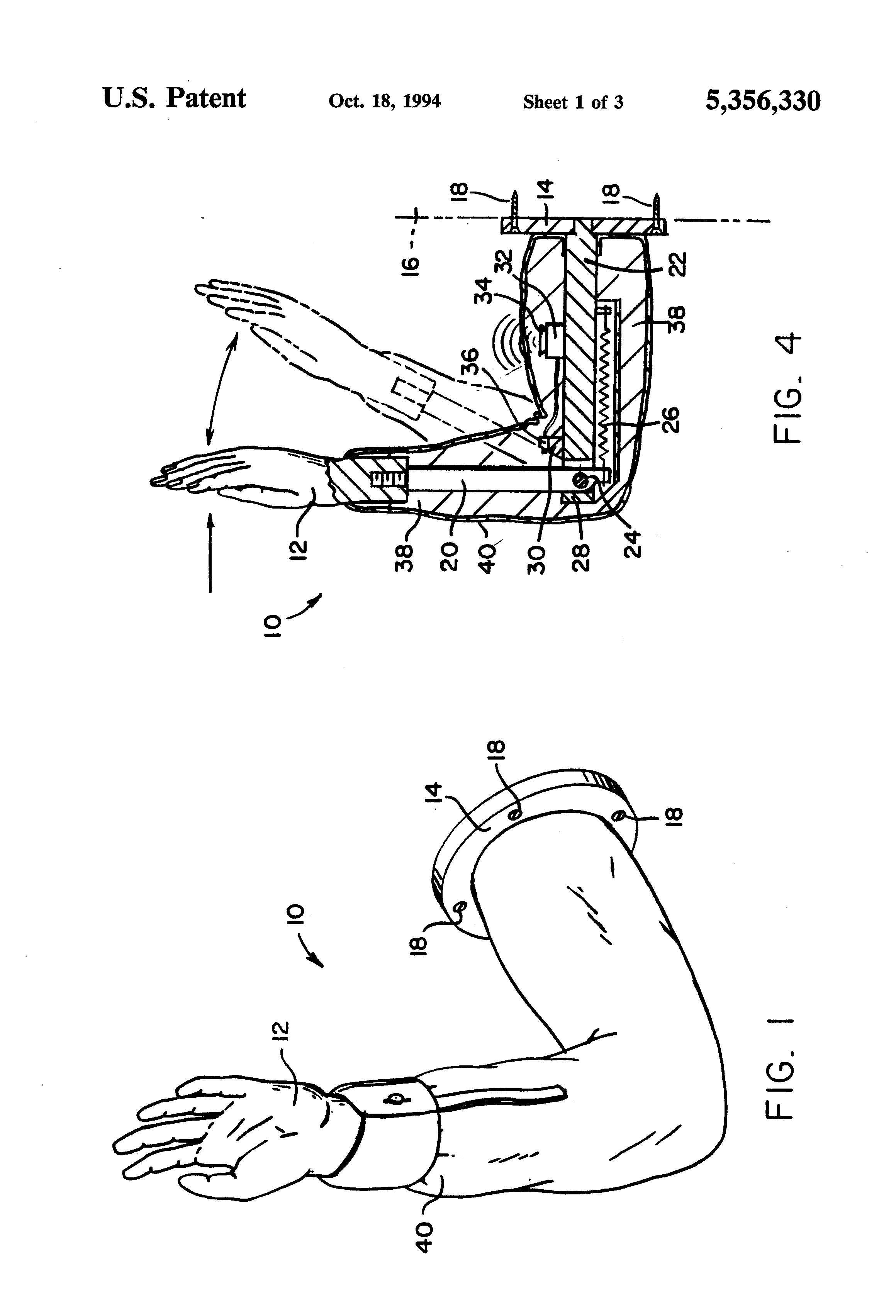
Apparatus For Simulating a "High Five"

US 5356330 A

Albert Cohen was concerned with the disadvantages of watching sports games alone and therefore developed an apparatus which would allow lonely sports fans to share the excitement of a 'high-five' with this device. In fact, in the patent he explains, "During a televised sporting event, a "high-five" is commonly shared between fans to express the joy...of a touchdown, home run,...[etc]. Unfortunately, as known in the art, a "high-five" requires the mutual hand slapping of two participants... As such, a solitary fan is unable to perform a "high five" to express excitement during a televised sporting event."

This simulated hand device can be mounted against a "table, wall, floor, or the like", the patent states.

As if the aforementioned purpose of this invention wasn't enough, Cohen further explains, "...the hand-arm configuration synergistically improves the hand-eye coordination of a user..., provides an exercise device for enhancing the jumping skils of a user. More specifically, when the hand-arm configuration is mounted ata suficient height above the normal reach of a user, th user must jump upwards to strike the simulated hand, thereby simulating many of the jumping drills commonly practiced by basketball players. As such, the leg strength and coordination of a user may be improved through the practice of the present invention."

I don't know about you, but he really sold it to me.


Garment having a buttocks cleavage revealing feature

US 6473908 B1

Thomas Bontems really outdid himself with this invention. Even though the buttocks crack doesn't have a generally positive connotation, it seems as though some individuals may want to expose that part of their body! 

This invention allows you to wear pants with a stylish cutout with sheer material, subtly exposing that precious part of your body. Bontems even has a Chevorlet logo cutout example in his images to show the possibility for corporate advertising!

According to Bontems, people actually do like to expose parts of their anatomy - the problem is that they aren't comfortable wearing tight fitting or low cut jeans. His invention "incorporates a revealing feature that does not detract from or govern the overall structure of the garment."

Too bad the patent expired just 5 years after he filed due to failure of paying the maintanence fee. 


User-Operated Amusement Apparatus For Kicking the User's Buttocks


US 6293874 B1

Joe Armstrong applied for this Buttocks Kicker patent back in 2000 - surprisingly enough, the USPTO granted Armstrong the patent. 

What's its use? Well, the patent states it is an amusement apparatus for "entertainment and comic relief whereby the plurality of rotating arms rotate when the user rotates the hand crank." 


I guess the inventors thought this had a great potential application for punishing your children or gaining some pleasure for new S&M techniques.... 

There have been other self-spanking patent inventions, but others required the resetting of the paddles after each blow to the behind. Thankfully, Joe Armstrong created a smooth and continuous self-spanking apparatus. 


Not only was this cranking technique application unanticipated, the prior art supports the novelty claim. Not only were existing self-spanking devices poorly operating, they were also operating via a means of pivot-trigger-reloading. 


Wednesday, April 22, 2015

Ford and the Patent Trolls

Back in 2014, Ford Motor Co. in San Francisco was sued 107 times for patent infringement by patent trolls. In fact, the numbers have been rolling up in the last 5 years - there were only 17 patent infringement lawsuits from trolls agains Ford back in 2009.

As a means to solve this rising problem, Ford recently signed a contract with RPX Corp., a type of open-source company. RPX claims to have over 200 companies signed and helps protect those companies from NPE litigation. Interestingly enough, RPX functions similarly to patent trolls in that they buy patents from the open market, but they claim to put their patents to good use. RPX removes "patents from circulation before they can become costly problem for [their] clients."

Other companies within RPX's member portfolio include Samsung, Intel, and Microsoft.


At the moment, RPX's patent portfolio predominantly includes information technology, but this may prove increasingly useful to Ford and other automotive companies in the next few years as cars are beginning to rely more heavily on software.


This won't be the first time in history that Ford has stood up to patent trolls. George Selden, a patent troll, began filing lawsuits against patent infringement around 1900 against companies like Cadillac, Packard, and Ford. All of the companies settled out of court with the exception of Ford. Henry Ford fought the lawsuit and won.


Sunday, April 12, 2015

Life360 v AGIS

Life360 is a family networking mobile app that allows family members to communication with and track down other family members' GPS locations, among other features.


Advanced Ground Information Systems (AGIS), on the other hand, has a funny looking website and claims to offer exchange of data, voice, and video for military tactical operations. Check out the front page of their website:


The funny bit was that AGIS sued Life360 the same week in which the latter had $50 million in financing, and when Life360 researched AGIS their LinkedIn showed no employees and their corporate headquarters was stationed at a waterfront mansion.

AGIS claimed that any company showing a location marker on a map or connects a group of individuals using a location-sharing service is infringing. The matter took to the federal court, and Life360 stated that AGIS would need to license their entire patent portfolio to all other startups, otherwise they will attempt to invalidate their entire IP portfolio. Luckily for Life360, their strong defense won them a verdict of non-infringement.

Life360 offers the following advice to others who are experience bullying from patent trolls:
- Go nuclear: publicly call them out for what they are
- Share information and resources: open-source all prior art collected, draw attention to your case by offering free legal advice to others in the field
- Go with your gut and commit to it: you're less likely to be approached with trolling lawsuits if you have a history of making the legal process difficult


Patent Troll: Personal Audio on Podcasting

Personal Audio, LLC is a company that was started in 1996 for the sole purpose of enforcing two podcasting patents. The company also earns licensing revenue from five other patents.

One of the claims filed in Personal Audio's patent includes:
(1) "An audio program and message distribution system in which a host system organized and transmits program segments to client subscriber locations."

These patent trolls have been suing companies like Apple, Samsung, Sandisk, and more for the last decade for infringing on their "podcasting" patent. The issue really hit media in 2013 when Personal Audio started demanding licensing fees from podcasters, including the comedian Adam Carolla and two television networks.

The big problem with Personal Audio is that they don't actually do podcasting - instead, they use their patent to claim infringement and collect payouts!

Finally on April 10, 2015 the USPTO invalidated Personal Audio's claims used to threaten podcasters in a petition for review from the Electronic Frontier Foundation (EFF). EFF was able to show that Personal Audio did not invent anything new before it filed its patent proved the prior art in which people have been podcasting for years previously.

Yay for crushing the patent trolls!


Innovation Act and Universities

There has been a lot of criticism towards the Innovation Act set forth by House back in February 2015. The Innovation Act is intended to eliminate patent trolling, but it may negatively impact universities who are joinders of patents through their alumni.

Some supporters of the bill state that it will protect small- and medium-sized business owners who typically settle when they can't fight the patent infringement costs in court; however, it may prove difficult for universities to enforce their own patent rights.

The two points in debate include:
(1) The losing party in the patent infringement is held liable for the winning party's legal fees.
(2) If the losing party cannot pay those fees, co-owners of a patent are required to cover the legal fees.

Point 1 is bad news to startup companies who have limited funds to pursue complicated litigation, while point 2 will involuntarily adjoin the university in select patent lawsuits. Although some argue that the universities likely will not be affected by these provisions due to the wording of the bill, others argue that the bill is too ambiguous about when fee shifting and joinder would apply.

As of now, more than 120 universities oppose this bill.


Monday, April 6, 2015

NPE (Part II)

Are NPE's actually the biggest contributors of patent litigation?

Just as Congress was preparing for the reform on patent policies, the US General Accountability Office (GAO) conducted a study on NPE's and patent litigation as a part of the historic America Invents Act (AIA). The findings actually showed that it is operating companies and not NPE's that drive most patent litigation.

Some interesting details from the GAO Study:

  • Only 1/5 of lawsuits are by NPE's while the rest of the majority is caused by companies which make products.
  • Increase in patent litigation between 2010 and 2011 is likely explained by the anticipation of change to the US patent system.
  • Patent trolls live to SUE

So if NPE's aren't the problem, what is wrong with the patent system?

The problem seems to reside within Patent Monetizing Entities, specifically software-related patents, and the fact that the PTO has not been doing enough to ensure a better quality of patents are being ensued. 


Bottom line is that the GAO report finds there is no patent crisis by identity of the patent owner and rather, the crisis lies within the quality of patents.


NPE (Part I)

Non-Practicing Entities (NPE's)

Also known as "patent trolls". According to PatentFreedom, NPE's are "any entity that earns or plans to earn the majority of its revenue from the licensing or enforcement of its patents." By this particular definition, NPE's do not sell products or services. Furthermore, what makes these patent trolls interesting is that they typically do not infringe on existing patents.

Many individuals end up lacking the time, man-power, and funds to undergo the necessary research and development for establishing a product from a patent. This leads to the licensing and outsourcing of patents which unfortunately usually leads to being swept up by these patent trolls.

For example, 25% of NPE's only enforce patents that they acquired through others.


The following is a charge of patent lawsuits that involve NPEs over time:
Patent Lawsuits Involving NPEs Over Time

This growth is observed due to:
  1. Growth in the market for patents
  2. Operating companies that are seeking to build a patent portfolio